[flutter_ffi_uvc] Flutter USB Camera
Criteria for choosing a technology
When I need a package while developing in Flutter, I approach it like this:
- Search pub.dev for candidate packages.
- Do a first pass of screening based on supported platforms, dependencies, project maturity, etc.
- For packages that pass that screening, build the example directly and check whether it builds cleanly and whether the flow I have in mind is actually feasible.
- Then read through the code to figure out the author’s intent — whether it’s usable for my project and whether there are any hidden risks.
When reviewing a library, I’d rather keep the scope of any fixes limited than chase errors too deeply.
I also prefer wrapping the original source over modifying it directly.
If fixing one error leads to a chain of further errors, I treat that as a structural problem and hold off on using the library.
Even if I can patch the errors I can see, hidden issues can end up costing a lot more down the line.
At the same time, I also ask myself “would it be better to just implement this myself?”, weighing factors like:
- The pros and cons compared to existing packages
- How much would be covered by the dependency versus how much I’d have to build myself, and the effort that implies
- Technical uncertainty — the general shape is clear, but there will be detail problems that surface once I actually get into it
Reviewing UVC libraries
For background on the UVC protocol, see the earlier post:
2026.04.10 - [Engineering/system (device, embedded)] - UVC(USB Video Class) Camera
libuvc - a C library that abstracts the UVC protocol and provides camera control and streaming functionality; internally it uses libusb to communicate with the device.
UVCCamera (saki4510t) - a library built on libuvc that supports UVC camera control and streaming on Android.
Last commit: October 2018
AndroidUSBCamera (jiangdongguo) - also a library built on libuvc that supports UVC camera control and streaming on Android.
Last commit: September 2024
For Flutter packages,
the common pattern is to wrap a native (Android/iOS) library and expose it through a MethodChannel.
The existing UVC Flutter packages are also built on top of either UVCCamera or AndroidUSBCamera.
After running the samples for UVCCamera and AndroidUSBCamera, the overall experience wasn’t smooth.
Considering building a Flutter UVC package myself
There are a few ways to implement a package that uses C/C++ from Flutter:
- Use libuvc on Android via JNI (MethodChannel)
- Wrap a library built with approach 1 (MethodChannel)
- Use libuvc directly from Flutter via Dart FFI (FFI)
Options 1 and 2 already turned out to have poor usability in the review above.
Looking at option 3:
- libuvc is a small repository, roughly 1-2MB, with a manageable number of files.
- The C libraries (.so) that need to be built alongside it are libusb and libjpeg-turbo, and
both already have their build configurations well maintained (higher odds it will actually build).
I’m also already comfortable with the structure of integrating a C/C++ native layer via Dart FFI, having previously built the mediapipe_face_mesh package.
2026.01.01 - [MediaPipe Face Mesh] Building a Flutter package
Overall, this looked feasible.
flutter_ffi_uvc
https://pub.dev/packages/flutter_ffi_uvc
An FFI package that integrates directly with libuvc with no intermediate library, supporting UVC camera connection, control, streaming, and preview.
libuvc doesn’t support iOS, and neither does flutter_ffi_uvc.
libuvc does have functions for discovering and connecting to devices, such as uvc_get_device_list() and uvc_open(),
but device discovery at the libusb level is limited by Android’s device permission model and system constraints.
So device discovery and USB permission acquisition/connection are handled through the Android USB Host API,
while the actual USB communication and UVC control/streaming are done in the C native layer built on libusb + libuvc.
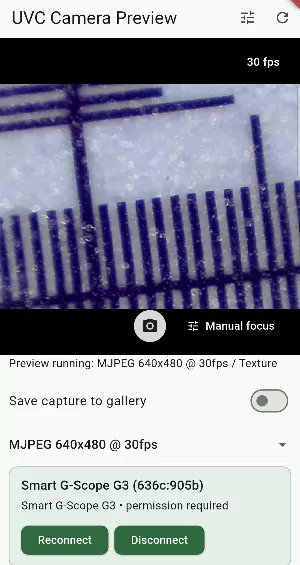 v0.1.0 example(1)
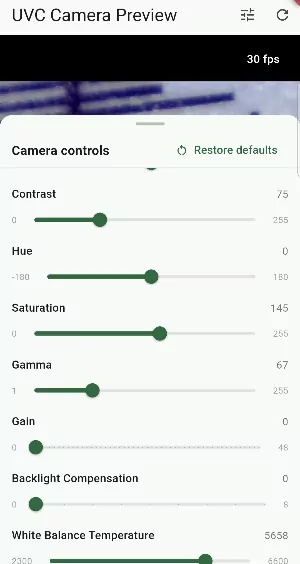 v0.1.0 example(2)
 v0.2.0 example .gif