Optical Engineer Written Exam Review (2026, 2nd Session)
Introduction to the Optical Engineer Certification
While browsing YES24, I came across a newly published book of past exam questions for the Optical Engineer (광학기사) certification.
I was curious about the optics subjects, so I went through the book once and then sat the exam.
(The book consists of 6 sets of practice questions.)
Written exam format
- Multiple choice (4 options), 20 questions per subject (30 minutes per subject)
- 80 questions total, 120 minutes
Subjects
- Geometric Optics and Optical Instruments
- Wave Optics
- Optical Measurement and Evaluation
- Lasers and Optoelectronics
To pass, you need at least 40 points in each subject and an average of 60 points or higher across all subjects.
For reference, in recent years the exam has only been held once a year, during the 2nd regular session.
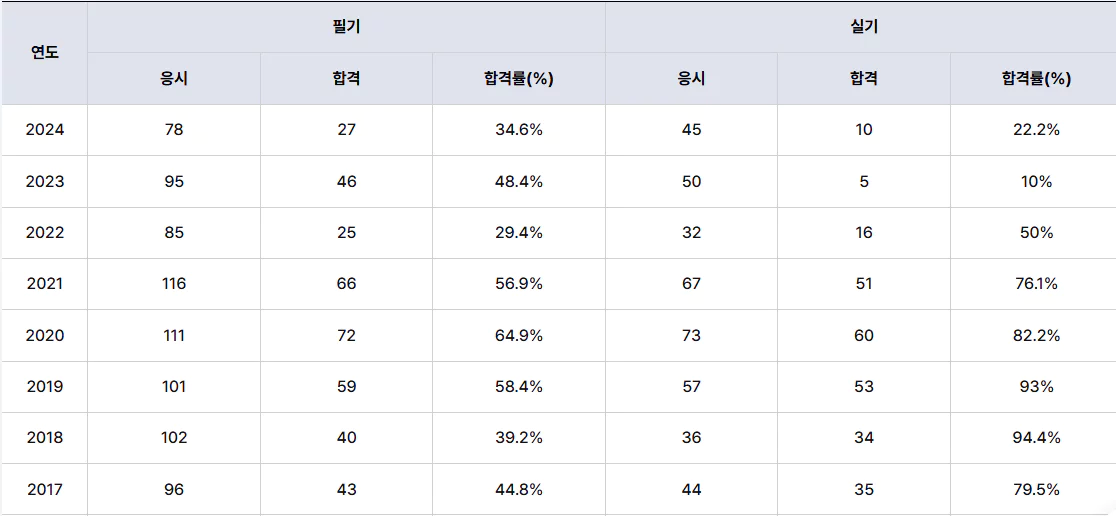 Number of applicants and pass rate
The number of applicants is small, around 100, so the pass rate isn’t very meaningful.
My Review
Failed.
(These days all engineer exams are CBT, so you get your score the moment you hit submit.)
I hadn’t studied enough to solve everything with full understanding,
so the key was how many questions resembled the past exam types I’d studied.
Unfortunately, a lot of the questions were unfamiliar types.
Still, I enjoyed studying for it.
I plan to take it again next year, and this time I want to study casually, just for the fun of it, in my spare time.
One thing I realized this time: whether it’s English or a certification exam, studying by going back and forth with AI makes it so much more enjoyable.
In the past, whenever I hit something I didn’t understand, I’d often just shrug it off with “I guess that’s how it is” and move on.
Now, by talking it through with AI, I can dig down to whatever depth I want.
For example, say the depth of understanding I’m curious about is a 6.
A professor or a textbook usually goes to a depth of 8-10, which can feel like overkill or more detail than I actually wanted.
On the other hand, if I only skim the surface (~3), I only understand the outer layer and never get to the intuitive insight, which isn’t fun either.
Now I can dial the depth to whatever I need depending on the situation.
Quick and shallow when I’m short on time, deeper when something catches my interest.
Even when I throw out a question in a messy, disorganized way, it still picks up on what I actually mean and explains it well, which makes studying genuinely enjoyable.
It’s also great at reconstructing questions. Right after walking out of the exam, with my memory still fuzzy, I asked something like:
“I don’t remember it clearly, but was there a question about where the nodal point is located relative to the principal point?
I think it was a question that mixed up the nodal point and the principal point?”
Even with such a vague, rambling question, it managed to recreate something very close to the actual exam question.
2026 Optical Engineer Written Exam Recap — Geometric Optics
I’ll wrap up by sharing a few questions I remember from Subject 1.
Question 1
A point object is located 30 cm below the boundary surface, inside a medium with refractive index 1.5.
When observed vertically from the side with refractive index 1.0, find the position of the image.
Solution
Image position = actual position / refractive index ratio
(refractive index ratio = refractive index on the observer’s side / refractive index on the object’s side)
= 30 × (1.0 / 1.5) = 20 cm
Equivalent terms
- image position
- apparent depth
- apparent position
- visual position
- observed position
Question 2
An object is located 30 cm to the left of the first convex lens, L1.
L1 has a focal length of 10 cm, and the second convex lens, L2, has a focal length of 20 cm.
The distance between the two lenses is 40 cm.
Where does the final image form relative to L2?
Solution
Thin lens imaging equation: 1/f = 1/a + 1/b
f: focal length
a: object distance
b: image distance
f = 10 cm
a = 30 cm
So the image distance b = 15 cm
An intermediate image forms 15 cm to the right of L1.
This intermediate image becomes the object for L2.
Since the intermediate image is 15 cm to the right of L1, relative to L2 it is 25 cm to the left.
f2 = 20 cm
a2 = 25 cm
So the image distance b2 = 100 cm
The final image forms 100 cm to the right of L2.
Question 3
In a certain optical system, the refractive index of the image-side medium is greater than that of the object-side medium. Which of the following is correct?
- The nodal point and the principal point always coincide.
- The nodal point is located on the image side of the principal point.
- The principal point is always to the right of the nodal point.
- The nodal point coincides with the focal point.
Solution
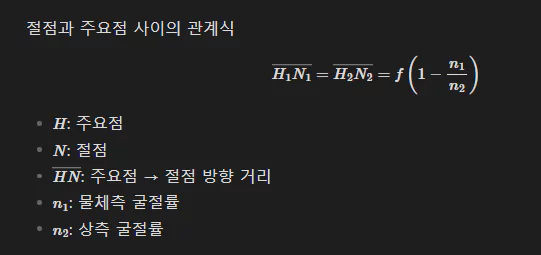 Relationship between the nodal point and the principal point
Since the segment runs from H to N,
if (+), the nodal point is to the right of the principal point;
if (-), the nodal point is to the left of the principal point.
In this problem, since (1-n1/n2) > 0, the nodal point is located on the image side of the principal point.
Equivalent terms
- image side\
- right side\
- direction of ray propagation