Strassen Algorithm - Matrix Multiplication
Standard matrix multiplication
 Standard matrix multiplication
1
2
3
4
5
6
7
8
9
// pseudocode
for i from 1 to n:                     // rows of A (1 to n)
    for j from 1 to n:                 // columns of B (1 to n)
        C[i][j] = 0                    // initialize each element of C
        for k from 1 to n:             // columns of A / rows of B (k from 1 to n)
            C[i][j] = C[i][j] + A[i][k] * B[k][j]
        end for
    end for
end for
The naive approach to matrix multiplication uses three nested loops, giving a time complexity of O(n^3).
Strassen matrix multiplication
The Strassen algorithm uses a divide-and-conquer approach to multiply two n x n matrices faster.
Assumption: split each matrix into 4 symmetric blocks.
 Matrix partitioning
 Standard matrix multiplication
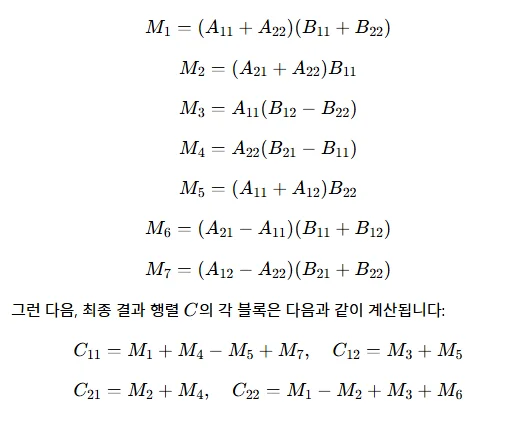
The straightforward approach requires 8 multiplications.
Strassen came up with a formula that reduces this to 7 multiplications.
 Strassen matrix multiplication
Since we first split the matrices, A[i][j] and B[i][j] are each n/2 * n/2 matrices.
So each M term is itself made up of n/2 * n/2 matrix multiplications.
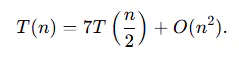
If we let T(n) denote the cost of an n * n matrix multiplication,
then T(n/2) is the cost of an n/2 * n/2 matrix multiplication,
Strassen recurrence relation
and we get the recurrence above, where T(n/2) appears 7 times.
Matrix addition/subtraction
Adding or subtracting two n*n matrices requires two nested for-loops over i and j, so it costs O(n^2).
In the Strassen recurrence, this is written as O((n/2)^2) ~= O(n^2).
Expanding the recurrence
Expanding the Strassen recurrence
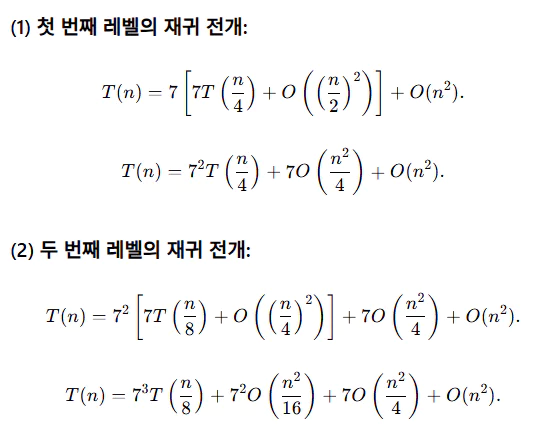
Let’s expand the recurrence step by step.
T(n/2) = 7T(n/4) + O((n/2)^2)
T(n/4) = 7T(n/8) + O((n/4)^2)
….
Generalizing the Strassen recurrence
Repeating this pattern, a general form emerges.
Let’s work out the first term and the second term separately.
The recursion bottoms out when n/(2^k) = 1, i.e., when k = log2(n), at which point T(1) = O(1).
First term
Substituting k in,
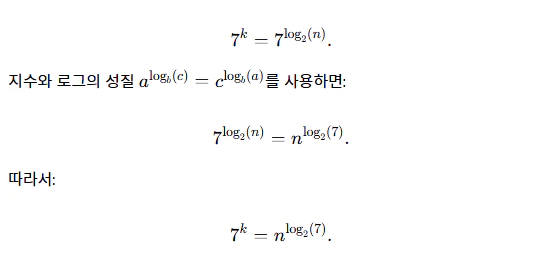
since n = O(n),
we can say 7^k = O(7^k) = O(n^log2(7)).
Second term
Generalizing the second term gives a geometric series with common ratio 7/4.
Geometric series sum formula
The leading coefficient works out to -4/3 (not that it matters much, since we’re after the time complexity).
As with the first term, let’s substitute k = log2(n).
Since Big-O only cares about the dominant term,
n^(log2(7/4) + 2) dominates over the leading n^2 term (when multiplying powers with the same base, the exponents add).
Since log2(7/4) + 2 = log2(7) - log2(4) + log2(4), this simplifies to n^(log2(7)).
So the second term also comes out to O(n^log2(7)).
Final result
 Generalizing the Strassen recurrence
Since both terms converge to O(n^log2(7)), the final time complexity is T(n) = O(n^log2(7)).
Since log2(7) = 2.80735…,
we’ve reduced the standard O(n^3) matrix multiplication down to O(n^2.807..).
Pros and cons of Strassen matrix multiplication
| Pros | Cons |
| Improves time complexity to O(n^2.81) | High constant factor hurts performance on small matrices |
| Well-suited to parallelization (divide-and-conquer) | Can introduce floating-point precision issues |
| Delivers real performance gains on large matrices | Uses more memory |
| Inspired many modern fast algorithms | Extra overhead for handling non-square matrices |
Afterword
It’s been a while since I dug into a recurrence relation just for the fun of following it through.